Certificate in Artificial Intelligence

Artificial Intelligence

The Certificate in Artificial Intelligence is a comprehensive, professionally structured programme designed to equip learners with the knowledge, strategic frameworks, and practical tools required to architect, implement, and govern intelligent systems across modern organisations.

In an increasingly automated and data driven global environment, AI proficiency is no longer a futuristic concept; it is a core professional competency. This course introduces learners to the fundamental principles of the machine learning lifecycle, explores how algorithmic intelligence impacts organisational efficiency, and demonstrates how Generative AI and predictive modeling support better decision-making, enhanced customer experiences, and long-term innovation.

The programme begins by establishing a strong foundation in AI theory, including the distinction between Narrow AI and General AI, the mechanics of Neural Networks, and the evolution of Large Language Models (LLMs). Learners then progress into practical application, mastering techniques in prompt engineering, data preprocessing, ethical AI governance, and the deployment of autonomous agents to solve real-world business challenges.

Course Price

£299,99
 
CPD Credits: 40
  • Duration: 4-6 weeks | Flexible Duration
  • Mode of Study: 100% Online Learning Environment | Study from any location, on any device.
  • Certificate: Immediate digital certificate issuance upon completion
  • Unlimited assessment: Retakes at no additional cost

Why Does This Project Management Specialist Course Stands Out?

What makes this Certificate in Artificial Intelligence stand out in 2026 is its transition from “AI Awareness” to “AI Agency.” While most introductory courses focus on how to talk to AI, this programme focuses on how to build with it.

Here are the four pillars that differentiate this course from standard offerings:

1. Shift from Prompting to “Agentic Workflows”

Most courses teach you how to write a better prompt. This programme teaches you to build AI Agents—autonomous systems that can plan, use tools, and execute multi-step tasks without constant human intervention. You won’t just learn to ask an LLM for a report; you’ll learn to build an agent that researches the web, analyzes a database, and formats a document automatically.

2. “Vibe Coding” & Modern Stack Integration

The 2026 curriculum embraces the “Vibe Coding” movement—using natural language to generate high-quality code.

 
  • The Difference: Instead of spending weeks on syntax, you focus on System Architecture.

  • The Tools: You’ll gain hands-on experience with the latest enterprise stacks, such as Google Vertex AI, LangGraph, and CrewAI, ensuring your skills are production-ready, not just theoretical.

3. Applied Ethics & Governance (The “AIGP” Standard)

As global AI regulations (like the EU AI Act and updated regional guidelines) have matured, this course includes a dedicated track on AI Governance.

  • You don’t just learn that bias is “bad”; you learn the technical methods for bias detection, red-teaming models, and creating “Human-in-the-loop” safeguards that satisfy modern legal compliance.

4. The Live Portfolio Requirement

In 2026, a certificate alone is rarely enough to secure a role. This programme stands out by requiring a Capstone Implementation:

  • The Deliverable: You must deploy a functional AI solution—such as a custom-tuned RAG (Retrieval-Augmented Generation) system or a multi-agent automation workflow—to a live environment.
  • The Result: You leave the course not just with a digital badge, but with a verified GitHub repository or live demo that proves your ability to deliver ROI to an organization.

Learning Outcomes

Upon completion of this development material, learner will be able to understand:

  • Foundations of Artificial Intelligence
  • Machine Learning & Statistical Intelligence
  • Deep Learning, Modern Architectures & Generative AI
  • AI Systems, Deployment, Governance & Future Directions

What You Will Learn?

Part 1: Foundations of Artificial Intelligence

  • What Is Intelligence? What Is Artificial Intelligence?
  • Historical & Philosophical Foundations of Artificial Intelligence
  • Intelligent Agents, Rationality & Environments
  • Problem Formulation, Search & Optimization
  • Knowledge, Reasoning & Decision-Making

Part 2: Machine Learning & Statistical Intelligence

  • Learning as inference from data
  • Supervised, unsupervised, and semi-supervised learning
  • Bias-variance trade-off
  • Overfitting, underfitting, regularization
  • Probabilistic models and Bayesian thinkingM
  • Model evaluation, uncertainty, and robustness

Part 3: Deep Learning, Modern Architectures & Generative AI

  • Neural networks as representation learners
  • Optimisation and training dynamics
  • Convolutional and recurrent architectures
  • Attention mechanisms and Transformers
  • Large-scale models and foundation models
  • Generative models (VAEs, GANs, diffusion-conceptually)
  • Failure modes of deep learning systems

Part 4: AI Systems, Deployment, Governance & Future Directions

  • AI systems vs models
  • Data pipelines and lifecycle thinking
  • Monitoring, drift, and failure detection
  • Generative AI in real-world systems
  • Explainability and transparency
  • Risk, bias, and misuseG
  • overnance, regulation, and accountability
  • Sustainability, energy, and societal impact
  • Future directions of AI

Career Opportunities After This Course?

Completing a Certificate in Artificial Intelligence in 2026 opens a diverse range of high-paying career paths, as AI has evolved from a niche IT experiment into the primary engine of global business operations.

Whether you come from a technical or non-technical background, the job market is currently prioritizing “AI-augmented” roles that combine domain expertise with AI fluency.

🛠️ Technical & Engineering Roles

For those who focused on the coding and architecture modules of the certificate.

  • AI Agent Architect: One of the fastest-growing titles in 2026. You design “Agentic Workflows” where multiple AI agents collaborate to solve complex business problems (e.g., an automated supply chain agent).
  • Machine Learning Operations (MLOps) Engineer: Focuses on the “plumbing” of AI—ensuring models stay accurate, secure, and cost-effective after they are deployed.
  • AI Security & Red Teaming Specialist: An “ethical hacker” for AI. You test models for vulnerabilities like prompt injection, data poisoning, and algorithmic bias.
  • NLP / Computer Vision Engineer: Specialized roles focusing on how machines process human language or visual data for industries like healthcare diagnostics or autonomous retail.

📈 Strategic & Management Roles

For those who focused on the integration, ethics, and business strategy modules.

  • AI Product Manager: Acts as the bridge between technical teams and business goals. You define the “What” and “Why” of AI products, ensuring they solve real user needs without failing in production.
  • AI Ethics & Compliance Officer: With 2026 regulations (like the EU AI Act) now in full force, companies need specialists to ensure their AI usage is transparent, fair, and legally compliant.
  • AI Enablement & Literacy Lead: A corporate role focused on upskilling an entire workforce. You design the internal “AI Playbook” and teach employees how to use tools effectively and safely.
  • GEO/AEO Strategist: “Generative Engine Optimization.” As traditional search engines decline, companies hire experts to ensure their brand is correctly cited and recommended by AI models like Gemini and SearchGPT.

Why Your Certificate is the "New Resume"

In the current market, employers are looking for Evidence of Application. Your certificate is most valuable when paired with:

  1. A Live Portfolio: A link to a functional AI agent or a GitHub repository showing “Vibe Coding” projects.
  2. Hybrid Skills: Combining AI with another field (e.g., AI + Marketing, AI + Law, or AI + Healthcare).
  3. Continuous Learning: Proof that you are updated on “Reasoning Models” (like the o1 series) and the latest multimodal capabilities.

Pro Tip: By 2026, 37% of companies expect to replace certain routine tasks with AI, but they are simultaneously creating millions of new roles that require a human to manage that AI. Your goal is to be the manager, not the replaced.

Delivered and Certified By

This program is delivered by the London Campus of Higher Studies – LCHS, a reputable institution committed to academic excellence and professional development. Upon successful completion, participants are awarded a certificate accredited by CPD, ensuring global recognition and alignment with continued professional development standards.

Frequently Asked Questions

Who Is This Course For?

The Certificate in Artificial Intelligence is specifically tailored for:

  1. The Career Changer (Non-Technical)

If you are currently in a field like Marketing, HR, Finance, or Administration, this course is your bridge to the “AI-Augmented” version of your career.

  • Focus: Learning how to use AI to automate reporting, draft high-quality content, and manage departmental workflows without needing to write complex code.
  1. Strategic Leaders & Managers

For Directors, Project Managers, and Business Owners who need to make high-stakes decisions about technology.

  • Focus: Understanding the ROI of AI, how to lead an AI transformation, and how to navigate the legal and ethical risks of deploying automated systems in a corporate environment.
  1. Aspiring AI Engineers & Developers

For IT Professionals or Students with some coding background (like basic Python) who want to move into specialized technical roles.

  • Focus: Moving beyond basic prompts to building “Agentic Workflows,” managing MLOps (Machine Learning Operations), and integrating LLMs into existing software applications.
  1. Data Analysts & Researchers

For those who already work with information but want to upgrade their toolkit from traditional statistics to Predictive AI and NLP.

Focus: Using AI to find hidden patterns in massive datasets and using “Reasoning Models” to generate deeper insights faster than traditional methods.

How do I enroll in the course?

You can enroll directly through the LCHS website or reach out to their admissions team for guidance. Enrollment is straightforward and always open.

Will I receive a certificate?

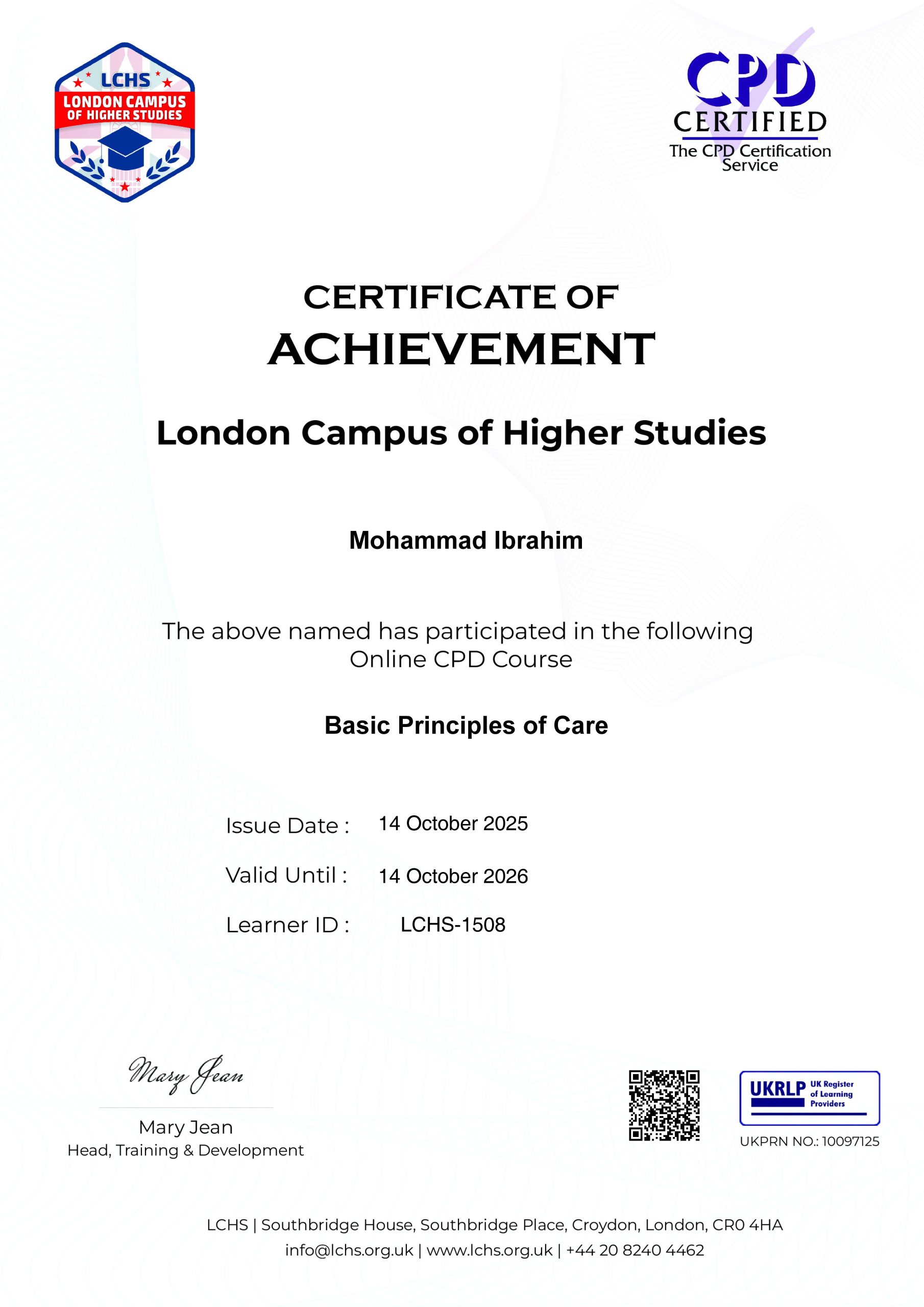
Yes! Upon successful completion, you’ll receive a CPD UK-accredited certificate by London Campus of Higher Studies – LCHS —a valuable addition to your professional portfolio.

How long does it take to complete the course?

Most learners complete the course in 4-6 Weeks, depending on their pace and schedule flexibility.

Is this recognised by employers?

As, London Campus of Higher Studies – LCHS is an official member of renowned CPD certification service and CPD UK accreditation is widely recognised by employers across the Worldwide, adding credibility to your resume or career progression goals.

In the current job market, where data breaches and ransomware are top corporate concerns, being able to bridge the gap between technical security and business risk is a high-value skill.